
How to Apply Credit Memo to invoice in Oracle Payables


How to Apply Credit Memo to invoice in Oracle Payables

In this below post, We will Create the Credit Memo in Oracle payables and then Apply this credit Memo in the Standard Payables Invoice.
These are the Below Steps We will perform to Apply Credit Memo in Oracle Payable.
1: Enter a Credit/Debit Memo in the Invoice Workbench. Enter a negative amount. Do not manually enter the distributions.
2: In the Match Action field scroll to Match Action field. Using drop down select Invoice.
3: Click on the Correction button.
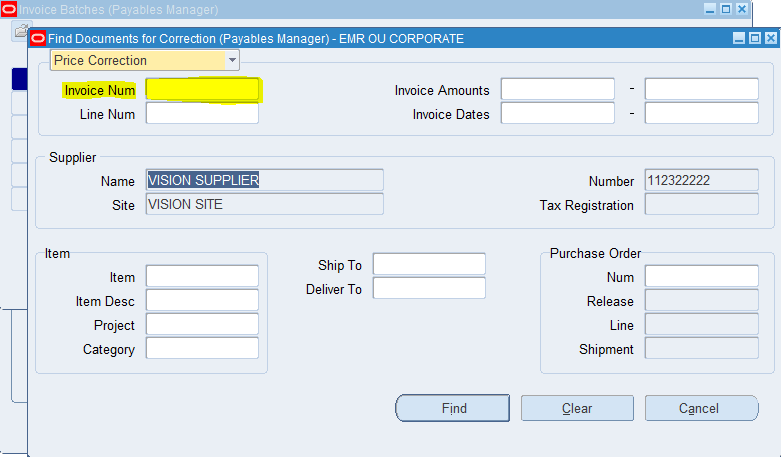
4: Enter search criteria for the invoice, in the Find Documents for Correction window. Click on the Find button.
Payables navigates to the Invoice Corrections window.
To see more information about an invoice, you can select it and click on the Invoice Overview button.
5: Select the invoice and enter a Credit Amount.
You can do the line level matching by clicking on Select Lines button.
Select each invoice line you want to match to and enter a Credit Amount.
6: Choose the Correct button to correct the invoice.
To review the new invoice lines, choose the lines tab from the Invoices window.
 
How to Apply Credit Memo to invoice in Oracle Payables
 
How to Apply Credit Memo to invoice in Oracle Payables
 
How to Apply Credit Memo to invoice in Oracle Payables


Comments

Popular posts from this blog

R12 Oracle E-Business Tax Configuration Guide

Applies to: Oracle E-Business Tax - Version: 12.0 to 12.2 Information in this document applies to any platform. Abstract R12 Oracle E-Business Tax Configuration Guide Document History R12 Oracle E-Business Tax Configuration 1. Tax Basic Tax Configuration Tax Definition: comprises the tax data that you set up for each tax regime and tax that your company or institution is subject to. The Tax Authority designates the regulations and rates that apply to the tax regime. Required Task List a) External Dependencies Create First Party: Legal Entity and Establishments Create Reporting and Collecting Tax Authorities b) Tax Configuration Create Tax Authorities Party Tax Profiles Create Tax Regimes Create First Party Legal Entity Party Tax Profile Create Tax Create Tax Status Create Tax Jurisdictions Tax Rate Responsibility: Tax Manager Path: Tax Managers -> Tax Managers -> Home Complete the following setup tasks: -Legal Entities and Establishments -Reporting and Collecting Tax Authorities ...

Create Accounting for a Payment generates errors 95333 and 95359

Create Accounting for a Payment generates errors 95333 and 95359 Error: 95333: A conversion rate does not exist to convert USD to AUD for the conversion type Corporate and conversion date 20-MAR-09 for line -25. Please use the Daily Rates form in General Ledger to enter a conversion rate for these currencies, conversion date and conversion type. 95359: There is no accounted amount for the subledger journal entry line. Please inform your system administrator or support representative that: The source assigned to the accounting attribute Accounted Amount has no value for extract line number 88547. Please make sure the source assigned to the accounting attribute Accounted Amount has a valid value, or assign a different source to this accounting attribute. Solution: 1. Specify a conversion rate for the currencies and conversion date mentioned in the error message 95333 Navigation under the General Ledger responsibility: Setup > Currencies > Currency Rates Manager > Daily Rates ...

R12: Payables Holds Explained – Why They are Applied and How to Remove

Invoice Validation checks the matching, tax, period status, exchange rate, and distribution information for invoices you enter. If an invoice has a hold, you can release the hold by correcting the exception that caused Invoice Validation to apply the hold by updating the invoice or the purchase order, or changing the invoice tolerances. Then resubmit Invoice Validation to release the hold. In the Invoice Holds tab, you can manually release certain invoice holds, even if you have not resolved the matching error condition. Here are some of the regular holds and explanation Account Holds Payables uses holds with this type to identify invoices with invalid or incorrect accounts. An invalid account prevents payment of an invoice and prevents Payables from creating accounting entries for an invoice or payment. Dist Acct Invalid:  Invoice distribution distributed to invalid account. To release the holds you must correct account and resubmit invoice validation. ERV Acct Invalid: ...